
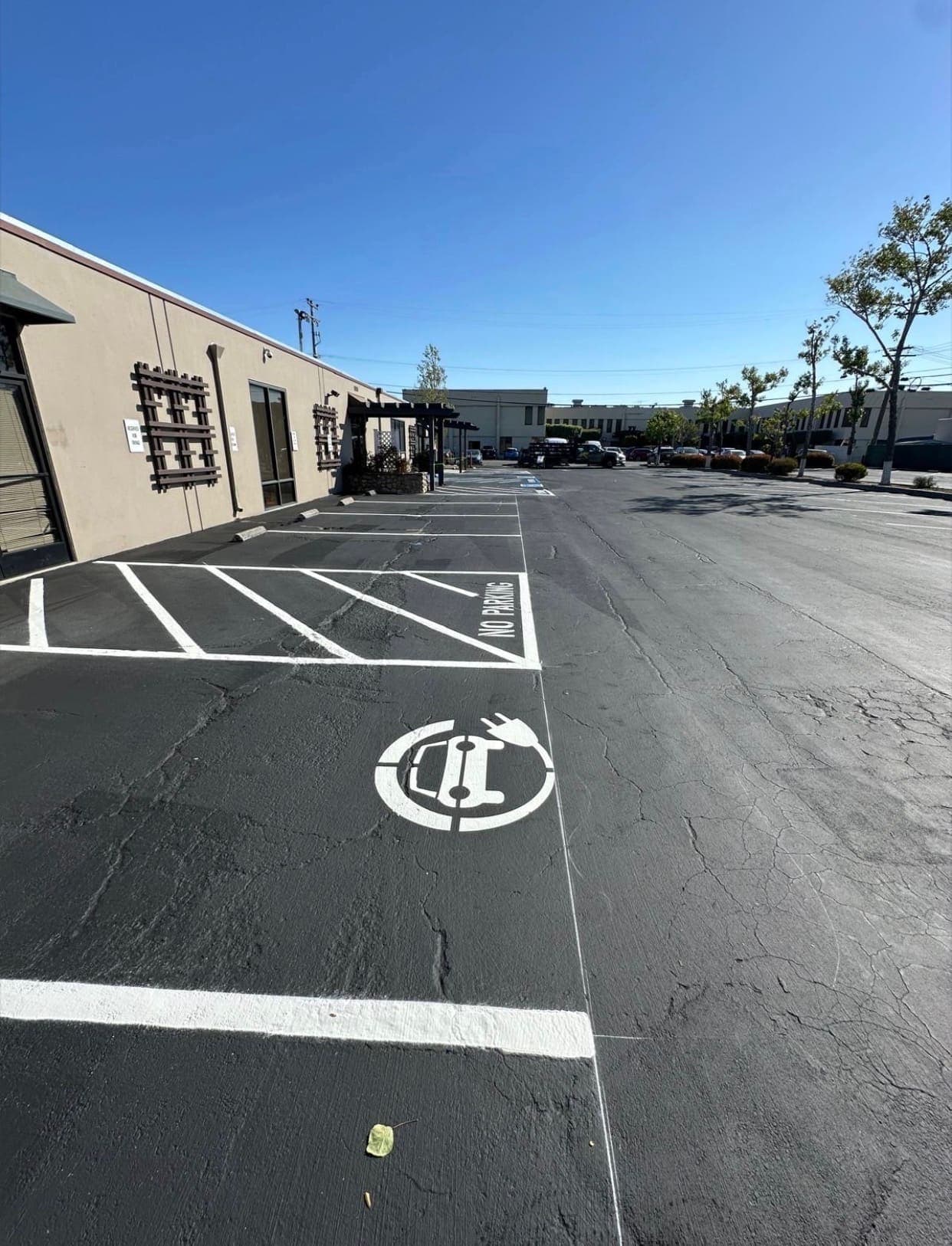
Every asphalt lot we look at is somewhere on the same curve. New pavement is black, tight, and flexible. Sun and water slowly pull the oils out of it, it turns gray and brittle, small cracks open, water gets through those cracks into the base, and the base starts to move. Once the base moves, the surface breaks up no matter what you put on top of it. The whole job of pavement maintenance is to stop that sequence as early and as cheaply as possible, and the mistake we see most often is buying the fix for the stage the lot was in two years ago.
Stage one: gray, dry, hairline cracks
The surface has faded from black to gray, the aggregate is starting to show, and there are thin cracks you can't fit a coin into. Nothing is loose and the lot drives fine. This is the seal coat window. Crack fill closes the openings so water stays out of the base, and the seal coat replaces the surface oils the sun took, which keeps the top from raveling. It is the least expensive thing you will ever do to this pavement, and it only works while the cracks are small and the base is still dry.
Stage two: wider cracks, raveling, isolated soft spots
Cracks have opened enough to hold water, edges are fraying into loose gravel, and there may be a few spots where the surface has started to alligator, that web of small interlocking cracks that looks like reptile skin. The base is still mostly sound but it has been wet. This is overlay territory. We cut out and patch the failed spots full depth, then put a new layer of hot mix over the whole surface so the lot drives like new pavement. Grading gets corrected at the same time so water actually leaves the lot instead of pooling where it was pooling before.
- Overlays need a sound base. The new layer is only as good as what it sits on. If more than a small share of the lot is alligatored, an overlay is a two-year fix, not a ten-year one.
- Watch your elevations. An overlay raises the surface. Curbs, drains, ADA landings, and door thresholds all have to be checked so the new lot still meets them correctly. We survey this before we quote it.
- Phasing keeps you open. Overlays on active retail and industrial lots get done in sections so tenants keep parking and trucks keep moving.
Stage three: alligatoring, rutting, potholes, base failure
Large areas of interlocking cracks, wheel-path ruts, depressions that hold water, and potholes that come back after every patch. The surface is telling you the base under it has failed. At this point sealing or overlaying is throwing money at the wrong layer. Full-depth replacement means removing the asphalt and the failed base, correcting the subgrade, placing and compacting new base rock, and paving a proper section on top. It is the most expensive option, and it is the only one that actually resets the curve.
Why the timing matters more than the product
The gap between stage one and stage three is not a small price difference; it is the difference between maintenance and reconstruction. A lot that gets crack fill and seal coat on a regular calendar can stay in stage one for a long time. A lot that skips it slides through stage two and into stage three, and the seal coat you saved on pays for a fraction of the base rock. This is why our estimators talk about a maintenance calendar instead of a one-time quote. Spreading the work across budget years is cheaper for you and easier to plan around for your tenants.
Paragon self-performs all three: seal coat and crack fill, overlays with full-depth patching, and complete remove-and-replace with new base. Because we do all of them with our own crews, we have no reason to push you up the ladder. We will tell you which stage your lot is in, quote that, and put the rest on a calendar.